
Whitehall plant played major role in WWII
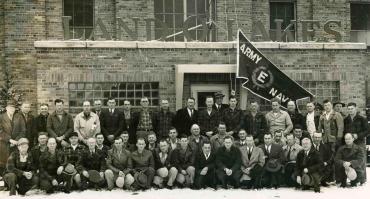
The Land O’Lakes plant in Whitehall was awarded two “E Flags” for its contribution to the United States Armed Forces in World War II. The above photo was provided to the Times by Whitehall High School history teacher and president of the Whitehall Area Historical Foundation, Gary Giese. Giese gave a presentation to WHS Class of 1963 regarding the Land O’Lakes plant on Sept. 14.
Few could’ve known that the stories would end up being connected.
In the Dec. 4, 1941 edition of the Whitehall Times it was reported that work had begun on the new Land O’Lakes plant being built in the city of Whitehall. The very next week a headline read: “Japan Attacks U.S. Possessions in Pacific.”
Along with headlines about local pioneers passing away, numerous drownings and a 13-game winning streak by the Whitehall Cubs, two constants on the front pages of the Times were updates about the construction of the plant and local connections to World War II.
A few years later, the local plant was honored for its contributions to the war.
In fact, on Nov. 30, 1944, the Whitehall dry milk plant became the first in the nation to receive an Army-Navy Production Flag — known as an “E” flag.
Col. John N. Gage, U.S. Army, made the presentation address at a ceremony that day. According to an article in the Dec. 7, 1944 edition of the Times, Gage emphasized that while the “production of bombers and shells may seem more dramatic, fighting men must have food. It must reach them every day.” He lauded the Whitehall plant’s management and personnel for “having attained through great effort, maximum use of its time and equipment, an 18 to 20 percent increase over natural capacity.”
The award was a topic of an essay written by then Whitehall High School student Kelsey Kopp, which received national recognition. In the essay Kopp cited Herbert Pollack, M.D. from Mt. Sinai Hospital in New York City saying “’The specific nutrient deficiencies, especially that of protein, were responsible for much of the clinical symptomatology’ in emaciated patients. In other words,” Kopp continued, “until significant levels of protein are restored to the body, all other methods of treatment are rendered impossible. Land O’Lakes milk and egg powders were extremely rich in protein and allowed doctors to begin treatment much sooner than any other diet would have allowed. The protein-rich diet of powdered milk and eggs also drastically reduced the death rate in cases involving patients suffering from serious burns. To put this in perspective, out of 92,000 soldiers liberated from German prison camps during World War II and treated with a diet of Land O’ Lakes powdered milk and eggs, only eight died.”
Sgt. Kendall Digman, a member of Wisconsin’s 32nd Division and winner of the Purple Heart was quoted in the 1944 edition of the Times as saying “I have prayed for food like I never prayed for anything in my life and it is such splendid plants as this Land O’ Lakes dry milk plant at Whitehall, which made it possible for my prayers to be answered.”
John Brandt, president of Land O’ Lakes Creameries, Inc., made the acceptance speech after which Lieut. J.J. Elder, USNR, presented the Army-Navy “E” Award pins to the assembled personnel of the Whitehall plant. Eugene Bautch accepted the pins on behalf of 58 employees.
That story ran alongside a story about Wayne Stahoski, a torpedoman from Whitehall who had returned home on leave. Stahoski, 19 at the time, told about an attack he was a part of while submerged in a submarine.
In July of 1945, the company received its second “E” flag. The second flag carried a white star to indicate that it was the second award that has been won. Twenty-nine employees received “E” pins at that time. That story ran alongside a story about Pfc Lloyd Engen who had written home to tell his mother he had located fellow Whitehall soldier Cpl. Jackie DeBow in Italy.
Talk of a Land O’Lakes plant opening in Western Wisconsin began in Sept. of 1941. On Sept. 18, it was reported that 10 of the 19 representative of the western Wisconsin creameries voted in favor of building a so-called “flexible” milk plant in the area.
Representatives of Land O’Lakes visited possible sites for a plant in Independence and in Whitehall. The next week, the Times reported that Whitehall was picked. While the reasoning wasn’t reported in the Times, Kopp wrote that Whitehall was chosen because the city agreed to guarantee free taxes for two years.
At the time, it was reported that the company hoped to have the plant running by March. Construction began in December and, due to several weather-related delays, the plant did not open until September of 1942. A grand opening was held in October of that year.
Land O’Lakes operated in Whitehall until 1973 when it closed its doors. The building was purchased by an Iowa-owned firm, which opened Whitehall Village Products later that year.
The plant was located where International Ingredients Corporation currently sits in Whitehall. Current plant manager Tom Gilbertson said that the driers that were used at that time are still in operation today.
