
WIAA board votes to restructure wrestling tournament
Improvements to the team tournament series were a key part of the changes to the Wisconsin Interscholastic Athletic Association Wrestling Tournament, approved recently by the WIAA Board of Control.
Both Independence/Gilmanton coach Barry Schmitt and Gale-Ettrick-Trempealeau/Melrose-Mindoro coach Pete Peterson were a part of the process before the recommendation went before the WIAA board. And both saw a need for equality across all divisions and a better team wrestling format.
Schmitt was a part of a Wisconsin Wrestling Association committee that helped develop the new format. Peterson served on a WIAA advisory committee that approved the recommendation and sent it to the WIAA board for review. Both groups saw the changes as a way to grow the sport and improve the atmosphere of the team sectionals.
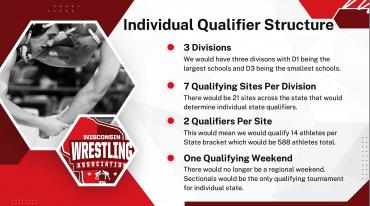
The regional round of the tournament has been eliminated, with all individuals competing in a sectional. From there, the top two individuals in each weight class will qualify for the state tournament, and the top six teams in each tournament will compete in a team sectional. There will be seven sectionals across the state; there were previously four.
One major change will be moving the team sectional from a Tuesday night to a Saturday, held the week after the individual sectional.
“Everybody hated that Tuesday night team sectional,” Schmitt said in an interview with the Times.
Peterson relayed a story from a couple of years ago when his team had to travel to River Valley.
“I got home at 1:59 a.m. … kids are supposed to be in school at 8 a.m. the next day,” Peterson said. “It’s not healthy for the kids, not healthy for the team.”
Peterson said there were also issues with some teams qualifying for the team sectional, and then sitting their best wrestlers because they didn’t think they would advance to the team state.
Under the new format, six teams will advance to a team sectional, determined by the top team scores at the individual sectionals. Previously, four teams advanced to the team sectional. The seven sectional champions will advance to the state tournament, and there will be one wild card team per division. The wild card team will be the highest seed that doesn’t win its sectional.
“We’re going to take six teams and put them in a gym and have them wrestle for a chance to go to the state tournament,” Peterson said. “That is a really cool environment…hopefully it’s a bigger deal.”
Schmitt initially pitched an all-inclusive tournament series, similar to basketball or baseball, in which each team would get to wrestle dual meets and advance to the state tournament. Though he said time constraints made that idea unfeasible.
Schmitt said the dual meet atmosphere was part of what made him fall in love with wrestling and will help the sport grow. He said having the tournament on a Saturday will make it more accessible for fans and help create an intense atmosphere.
“I grew up in that environment,” Schmitt said. “It was great to run out on that mat and have that gym packed and have those fans being so rabid.”
While his program could eventually benefit from the new format, Schmitt said he thinks it would’ve greatly benefited another Dairyland Conference squad, Whitehall, last year. Whitehall did not qualify for the team sectional because it didn’t have enough standout individuals, but Schmitt said they had a really good lineup and were a strong dual meet team. He thought the Norse could’ve qualified for the sectional under the new format and won a dual.
“It’s building your program just getting in those matches,” Schmitt said.
The change in the individual format might seem more drastic, but Schmitt said the numbers might make it a little easier for athletes to qualify for the individual state tournament.
Schmitt noted that while the number of wrestlers to advance to the state tournament from each weight bracket is reduced from three to two, there will also be fewer teams competing in each sectional, going from 26 to 29 to 16 to 18. There will be 14 wrestlers in each state bracket, with the first- and second-seeded receiving byes in the first round.
The total number of state qualifiers in Divisions Two and Three will increase from 168 to 196, while Division One qualifiers will see a reduction from 224 to 196. Likewise, there will be more total state tournament matches in Divisions Two and Three, going from 266 to 322. Evening out the number of teams and individuals across all three divisions was also an important aspect.
While Peterson’s squad has had plenty of postseason success — including state tournament appearances in 2018, 2019, and 2020 — he thinks the change will be a good thing.
“From the Titans’ perspective, we’re excited,” Peterson said. “We’re excited for the change.”

